

Breast cancer treatment and diagnosis
Breast Cancer
One in eight women will be diagnosed with breast cancer, making it the second most common cancer diagnosed in women in the United States after skin cancer. That means there will be 297,790 women diagnosed with invasive breast cancer, and another 55,720 diagnosed with non-invasive breast cancer this year. Men can also be diagnosed with breast cancer. In fact, it is estimated that 2,800 men will develop breast cancer this year.
When diagnosed early, breast cancer can be highly treatable.
Fortunately, an early diagnosis can mean more treatment options, and survivorship has drastically increased with over 3.8 million breast cancer survivors alive in the US today.

Chapter 1
What is breast cancer?
Breast cancer is the abnormal and uncontrollable growth of the cells lining the breast lobules or ducts. These cancerous cells have the potential to spread, or metastasize, to lymph nodes near the breast or other distant parts of the body, such as the liver, lungs, bones, or brain.
The causes of breast cancer are not fully understood, however, there are risk factors that can increase the likelihood of you or a loved one developing it.
The main risk factors for developing breast cancer are being female and older in age – most breast cancers occur in women over 50 years old. Other risk factors include:
- Genetic mutations – inheriting either BRCA1 or BRCA2 (Breast Cancer 1 or 2) gene mutations can increase your risk. These are the main two genes that are associated with heritable breast cancer (cancer that is passed between generations). Other genes that can increase the risk of developing breast cancer include PALB1, PTEM, TP53, ATM and CHEK2. It is recommended that you talk with a genetic counselor if your family has any of these gene mutations.
- Family history – You’re also more likely to develop breast cancer if there is an immediate family history of the disease in a first degree relative, such as your mother or a sister.
- Having early periods before the age of 12 and starting menopause after age 55.
- Having dense breast tissue – When present with other risk factors, you may be at an increased risk. Dense breast tissue can also make detecting small or early-stage breast cancers with mammogram more difficult. Enhanced screening with ultrasound and/or MRI may be needed in some cases.
- A personal history of breast cancer.
- Previous radiation therapy treatment to the chest or breasts before you’re 30 years old.
- If you took the drug diethylstilbestrol (DES) or your mother did while pregnant with you – DES is a drug that was given to women in the United States between 1940 and 1971 to prevent miscarriage.
There are other factors that can also increase your risk, including:
- Not participating in regular exercise.
- Being overweight after menopause.
- Taking certain forms of hormone replacement therapy during menopause or oral contraceptives (birth control pills) for more than five years.
- Becoming pregnant after the age of 30, not breastfeeding, or not having a full-term pregnancy.
- Consuming alcohol.
Having a risk factor for breast cancer doesn’t mean that you will definitely get it, but it makes you more likely than someone without that risk factor. Talk to your doctor about your personal risk of developing breast cancer and actions, including screenings, you can take to reduce your chances.
There are several early warning signs of breast cancer, and these can vary from person to person.
It’s important to remember that other benign conditions may cause changes to the breasts, and very often these relate to a simple infection or harmless cyst. However, it is important to talk to your doctor if you notice any changes in your breast.
The most common breast cancer symptom is a lump or mass that you can feel within the breast.
Other breast cancer symptoms can include:
- Changes in the size or shape of your breast
- Changes to the color of your skin (redness)
- Changes to how it feels—such as dimples
- Fluid (or blood) coming from one or both or your nipples when not breastfeeding
- Swelling of your breasts
- Changes to the appearance of your nipples, such as them turning inward (inversion)
- Crusting or a rash around your nipple
- Persistent pain in your breast or armpit
Non-invasive breast cancer
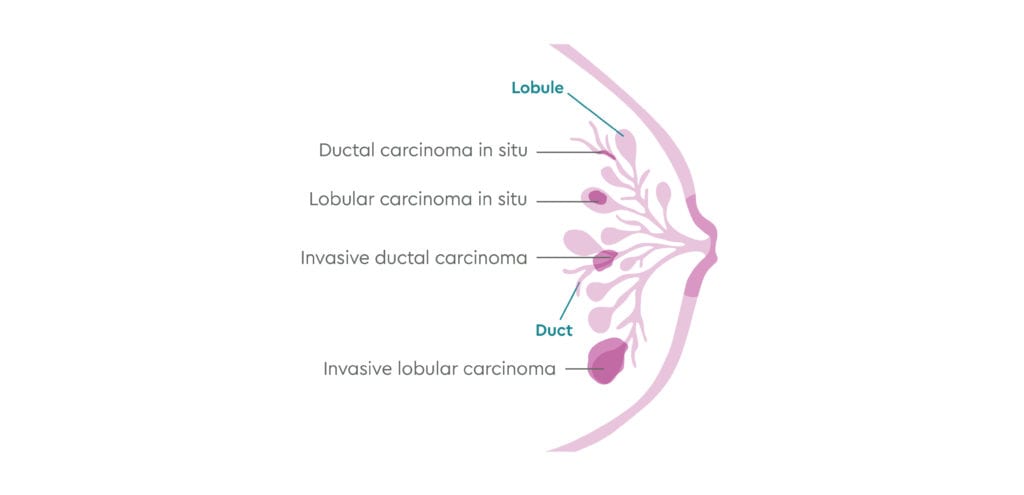
Non-invasive breast cancer is when the abnormal cells haven’t spread from the milk producing glands or ducts. These tumors can’t usually be felt by your doctor and instead are most frequently identified by routine mammography. Types of non-invasive breast disease include:
- Ductal carcinoma in situ (DCIS) – Cancer cells are found within the milk ducts of the breast and are usually treated with surgery, endocrine therapy (blocking effect of estrogen) and radiation therapy.
- Lobular carcinoma in situ (LCIS) – Abnormal cells are found within breast lobules and is usually treated with surgery alone. LCIS is not actually cancer, but it may slightly increase your risk of developing breast cancer in either breast (not just the breast where LCIS is discovered).
Invasive breast cancer
Invasive forms of breast cancer have spread beyond the milk ducts into other nearby tissues of the breast. Types of invasive breast cancer include:
- Infiltrating ductal carcinoma (IDC) – This type of breast cancer originates in the ductal tissue and is the most common cell type. It can be localized within the breast, or it can spread through the lymph system or bloodstream.
- Infiltrating lobular carcinoma (ILC) – This is the less common type of invasive breast cancer that tends to be difficult to detect with imaging. Because of this, invasive lobular carcinoma may be larger or more extensive at the time of surgery than initially believed based on imaging.
- Inflammatory Breast Cancer (IBC) – a rare but rapidly developing type of invasive breast cancer which can make the breast red, swollen and tender. The skin can have a characteristic appearance like orange skin “peau d’orange” due to infiltration of cancer cells into the dermal lymphatics.
Stages of Breast Cancer
- Early-stage breast cancer – Stage I and some Stage II breast cancers are generally considered to be early-stage or favorable disease. In this stage, the cancer has grown and sometimes spread to a nearby lymph node but still has a favorable biology if a lymph node is involved.
- Advanced-stage breast cancer – Stage III breast cancer usually means that either the tumor is large, there are many lymph nodes involved, or the cancer is aggressive / has an unfavorable biologic type. These cancers are often treated first with some form of systemic therapy (chemotherapy with or without a targeted or immunotherapy agent). A unique form of this category of disease is called “Inflammatory breast cancer” where the skin and breast change appearance very quickly because the skin becomes involved. This type of breast cancer should be treated as soon as possible as it can advance and spread quickly.
- Metastatic breast cancer – This category is when the cancer has spread beyond the breast and lymph nodes and has been found in distant site such as the liver, bones, lung or brain. This can also be called late-stage or Stage IV disease. The prognosis of this group of breast cancer depends on the amount of spread and the biology of the cancer (whether it is favorable such as estrogen positive or unfavorable such as triple negative). Metastatic breast cancer is generally treated only with systemic therapy such as chemotherapy, immunotherapy, targeted therapy or hormone therapy. Radiation therapy may also be used to help relieve symptoms of cancer that has spread to other areas of the body.
Biologic Types of Breast Cancer
- Estrogen receptor positive / HER2-negative breast cancer – This is generally a biologically favorable type of breast cancer that typically responds to endocrine therapy (blocking the effect of estrogen). Depending on the stage, it can be treated with surgery, radiation and systemic therapy. There are two general types of this biologic category: Luminal A (both the estrogen and progesterone receptors are positive) and Luminal B (the progesterone receptor may be negative, or the estrogen receptor may be partially positive).
- HER2-positive breast cancer – A type of cancer that can behave aggressively. This type of breast cancer tests positive for a protein called the human epidermal growth factor receptor 2 (HER2). In this instance, the HER2 protein is what drives the cancer growth. HER2-positive breast cancers most often respond to targeted therapies. Many HER2-positive breast cancers are treated with chemotherapy and targeted therapy (anti-HER2 therapy) before surgery and radiation, which is called neoadjuvant therapy.
- Triple-negative breast cancer – An aggressive form of breast cancer where the cells don’t produce estrogen or progesterone receptors, and also don’t make enough of the protein called ‘HER2’. This cancer type is typically more difficult to treat and is usually treated with chemotherapy combined with immunotherapy and, depending on the stage, many times also with surgery and radiation therapy.
While breast cancer treatments may be recommended by cancer type, advancements in precision medicine are allowing for more precise treatment options and tailored plans, customized to you. If you have been diagnosed with breast cancer, talk to your care team about what treatment options are most appropriate for you.
Chapter 2
Breast cancer screening
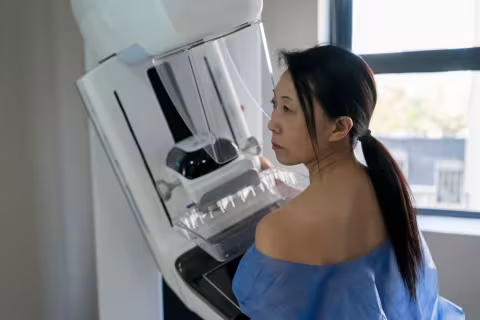
While some women experience signs and symptoms in their breast, many women don’t have any symptoms at all. That’s why compliance with routine annual exams and regular mammograms is highly recommended. Should your mammogram determine abnormal results, your doctor may recommend an ultrasound, breast magnetic resonance imaging (MRI), lab work and/or a biopsy. In some instances, your doctor may also perform genetic testing to see if you have any genes that predispose you to breast cancer.
If you have an abnormal mammogram or a concern about a possible breast cancer, find your nearest SunState Medical Specialists center to find out what diagnostic tests and scans are available in your local area. Whatever your outcome, our expert team will support you throughout your treatment journey.
If you are diagnosed with breast cancer, talk to your team about your treatment options. Treatment will vary depending upon the type of breast cancer, location and if the cancer has spread.
Request more information
Contact us today to find out how SunState Medical Specialists can help you.
Chapter 3
Surgery
Chapter 4
Medical Oncology
Systemic therapies (treatment that target the entire body) may be recommended before or after surgery to help with cure rates or reduce the changes of cancer returning. At SunState Medical Specialists, we offer a wide range of systemic drug therapies and the latest anti-cancer medications for the treatment of breast cancers. In some instances, your medical oncologist may order genetic or genomic testing to understand the makeup of your individual cancer and will discuss which treatment options are most appropriate for you.
Chemotherapy
Chemotherapy refers to drugs that destroy cancer cells. It may be used as a breast cancer treatment before or after surgery, and usually takes between three and six months to complete. Chemotherapy for breast cancer is usually given through the blood stream (intravenously / IV) at first, but in some cases may be given in pill form after surgery has been completed. The type of chemotherapy you’ll receive will also depend on your breast cancer stage, grade and the genetic or biologic make-up of your cancer.
Hormone or Endocrine therapy
Many breast tumors need a hormone, either estrogen or progesterone to continue to grow. Hormone or endocrine therapy for breast cancer works by blocking the appropriate hormones from binding to the cancer cells, or preventing your body from producing those hormones, in order to slow down the cancer growth. Hormonal therapy is usually provided as a pill but can also be an injection. It is also commonly used at the end of treatment to help reduce the risk of the cancer returning.
Immunotherapy
A relatively new type of treatment that is being used to treat some types of breast cancer is called immunotherapy. This category of medicines helps our own immune system recognize cancer cells as abnormal and in need of being cleared by the body. Depending on the stage of cancer, immunotherapy may be used together with other medicines (such as chemotherapy) or on its own.
Targeted therapy
Targeted therapy, also known as precision medicine, is a newer type of treatment that ‘targets’ cancer cells without affecting normal healthy cells. Targeted therapy seeks, attacks and blocks cellular activity that the cancer depends on to survive and grow. Targeted therapies help determine what DNA mutation is driving a cancer, based off of your tumor’s individual genomic and genetic make-up.
Clinical trials
Clinical trials examine how people respond to a new treatment and help identify possible side effects, while others compare existing treatments, test new ways to use or combine existing treatment, or observe how people respond to other factors that might affect their health. If you participate in a clinical trial, you may be one of the first to benefit from some of the latest treatment offerings, as well as open the door to new treatment pathways for future patients. Talk to your doctor to see what clinical trials are available to you.
Find your nearest SunState Medical Specialists center to find a medical oncologist who specializes in breast cancer treatment in your local area.

Chapter 5
Radiation Therapy
In addition to surgery and systemic therapies, radiation therapy is often administered after the breast cancer has been removed. Over the past several years, radiation therapy has advanced, allowing for a more targeted and precise approach that spares surrounding healthy tissue.
At SunState Medical Specialists, we use the latest-generation machines to deliver highly targeted radiation beams. The accuracy of these treatments, together with the expertise of our teams, helps our patients achieve the best possible outcomes. The type of breast cancer treatment your radiation oncologist recommends will depend on your diagnosis, if the cancer has spread to other parts of your body, your general health and personal preferences.
Breast cancer treatments
External beam radiation therapy (EBRT)
EBRT is delivered from outside of the body and aims an accurate x-ray beam from multiple angles directly toward the treatment site within the breast, chest wall or under the arm. It is typically performed on an outpatient basis, so there’s no hospital stay required, usually once a day over the course of a few weeks.
Accelerated partial breast irradiation (APBI)
APBI is a radiation therapy for some early-stage breast cancer patients that treats a smaller portion of your breast tissue than other radiation techniques. There are two different types of APBI:
- Breast brachytherapy, which is radiation given from the inside of the body. A catheter is inserted during surgery and afterwards, tiny radioactive seeds are guided into the catheters during treatment. Typically, breast brachytherapy is provided two times a day for up to five days. After treatment, the catheter is removed.
- EBRT, which is delivered from outside of the body. Unlike whole-breast EBRT, EBRT for APBI is delivered to only a portion of the breast and is usually given over a one to two-week period.
Intraoperative radiation therapy (IORT)
IORT is delivered at the time of surgery, allowing for a higher dose of radiation to directly target a tumor. It is typically used if you have an early-stage breast cancer and are undergoing a lumpectomy procedure. IORT is extremely precise and is given in one single dose instead of over the course of several weeks. Sometimes IORT is used on its own, and sometimes it is used before whole breast external beam radiation therapy.
3D-conformal radiation therapy (3D-CRT)
This form of radiation typically uses at least two beams that are shaped or modified by your radiation team to deliver a therapy that conforms to the desired treatment. The shaping of the beam is generally done by the medical dosimetrist or doctor to give you a personalized radiation plan.
Intensity-modulated radiation therapy (IMRT)
IMRT is an advanced external beam radiation therapy technique where the beams of radiation are precisely shaped to exactly match your tumor, which limits radiation exposure to adjacent healthy tissue.
Additional radiation services
At SunState Medical Specialists, we offer an advanced AlignRT® technology, which allows us to provide:
Tattoo-free radiation therapy through Surface - guided radiotherapy (SGRT)- Surface-guided radiation therapy uses sophisticated 3D camera technology to help your radiation therapy care team accurately position you for treatment each day. This technology monitors breathing position and any unintended movements you might make during the treatment which allows your treatment team to make sure your daily treatments are as accurate as possible. In many instances, we are able to do this without the use of tattoos for positioning. That means you aren’t left with a permanent visual reminder about your treatments in the future. The technology also monitors any unintended movements you might make during the treatment, and will pause the radiation until you are back in the correct position to reduce the amount of radiation reaching healthy tissues and organs.
Heart protection with deep inspiration breath hold (DIBH) - SunState Medical Specialists also uses surface-guided technology for deep inspiration breath hold, which is a breathing technique used during left-sided breast cancer treatment to help minimize exposing your heart to radiation during treatment. With AlignRT®, we monitor the position of your chest during treatment. Our team works to educate you on how to control your breathing pattern during treatment, so radiation is delivered only when you are in a deep inspiration, or when your heart is further away from the radiation beam.
If you struggle to be on your back or hold your breath, prone positioning radiation therapy may be another option to receive radiation therapy and protect the heart. In this instance, you may lie on your stomach to receive radiation. This position uses gravity to move the breast tissue away from the chest wall to safely deliver radiation therapy while minimizing dose to the heart.
Additional offerings
If you have been diagnosed with ductal carcinoma in situ (DCIS), an early-stage breast cancer where cancerous cells are found within the milk ducts, you may benefit for a risk assessment test to determine if radiation is appropriate for you after surgery. SunState Medical Specialists has partnered with PreludeDx to offer DCISionRT®, a simple lab test to determine the risk of the cancer spreading after surgery, to help women make an informed decision about their treatment plans.
There are several different radiation options and treatment durations available, and your radiation oncologist will work with you to personalize a plan that best meets your needs. Find your nearest SunState Medical Specialists center to find out what radiation options are available in your local area.
Chapter 6
Find a specialist in our network
Connect with a physician who specializes in your condition and can help guide your path to better health. SunState Medical Specialists physicians are based in Florida and currently accepting new patients. Find a physician near you and take the next step toward care.

Chapter 7