

Head and neck surgery
SunState Medical Specialists provides expert surgical care for cancerous and benign (non-cancerous) conditions across southwest Florida.
Advanced head and neck surgical care
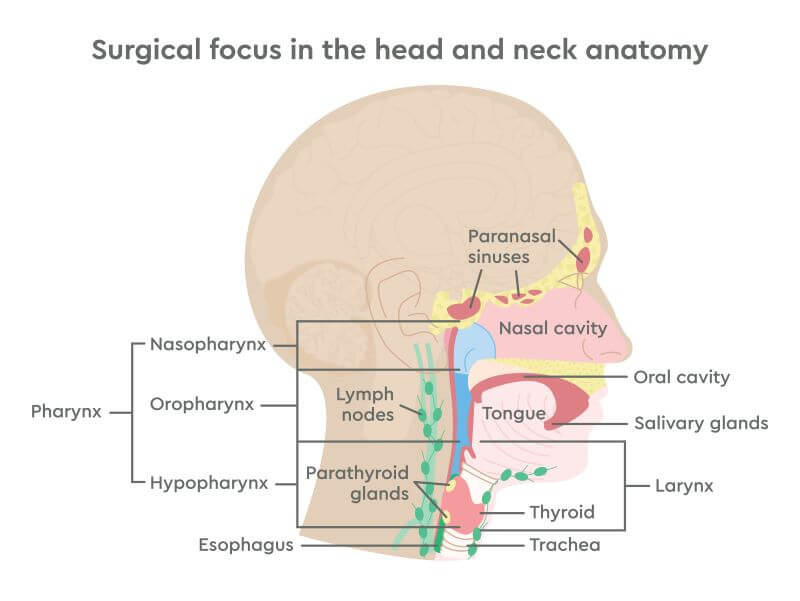
At SunState Medical Specialists, we provide specialized treatment for conditions affecting the head, neck, mouth, throat, glands, and sinuses, including both benign and malignant tumors and thyroid disorders.
There are several factors to consider when treating head and neck cancers. Dr. Larson talks about those factors, treatment options, and advancements in technology, including minimally invasive surgery. For every patient we treat, our focus is on providing personalized care for the best possible patient outcomes.
Conditions we treat
Oral cavity cancers
Cancer of the oral cavity includes the lips, the inside lining of the lips and cheeks, the teeth, the gums, the front two-thirds of the tongue, the floor of the mouth below the tongue, the bony roof of the mouth (hard palate), and the area behind the wisdom teeth.1
Oropharyngeal cancers
Oropharyngeal cancer is cancer in your oropharynx, the middle section of your throat (pharynx) that makes saliva, keeps your mouth and throat moist, and helps you digest food.2
Nasopharyngeal cancer
Nasopharyngeal cancer starts as a growth of cells in the nasopharynx. The nasopharynx is the upper part of the throat and sits behind the nose. Nasopharyngeal cancer is rare in the United States. It happens much more often in other parts of the world, mainly Southeast Asia.3
Laryngeal cancers
Laryngeal cancer is an overgrowth of cells in the larynx, part of your throat. Your larynx helps you speak, breathe, and swallow and contains your vocal cords.4
Hypopharyngeal cancers
Hypopharyngeal cancer is an abnormal growth of cancer cells in a region of the lower throat known as the hypopharynx. The hypopharynx lies within the lower neck and throat behind the voice box just above the inlet to the esophagus.5
Nasal cavity and paranasal sinus cancers
Nasal cavity and paranasal sinus cancers start in the head and neck area. Cancer that starts in the nasal cavity (the opening behind the nose) is called nasal cavity cancer. Cancer that starts in the paranasal sinuses (air-filled spaces in the bones around the nose) is called paranasal sinus cancer. These cancers start when cells in the nasal cavity and paranasal sinus grow out of control and crowd out normal cells.6
Salivary gland cancers
Salivary gland cancer is a term used to describe malignant tumors that affect your salivary glands. Your salivary glands are located in your mouth and throat. They produce saliva — or spit — that helps your digestive system begin breaking down food. Salivary gland tumors may be benign (noncancerous) or malignant (cancerous). Both types may affect any of your salivary glands.7
Parathyroid cancer is a rare form of endocrine gland cancer that develops in the parathyroid glands. It is estimated that less than 100 people in the U.S. are diagnosed with parathyroid cancer each year. Benign (noncancerous) tumors of the parathyroid gland are much more common than parathyroid cancers.
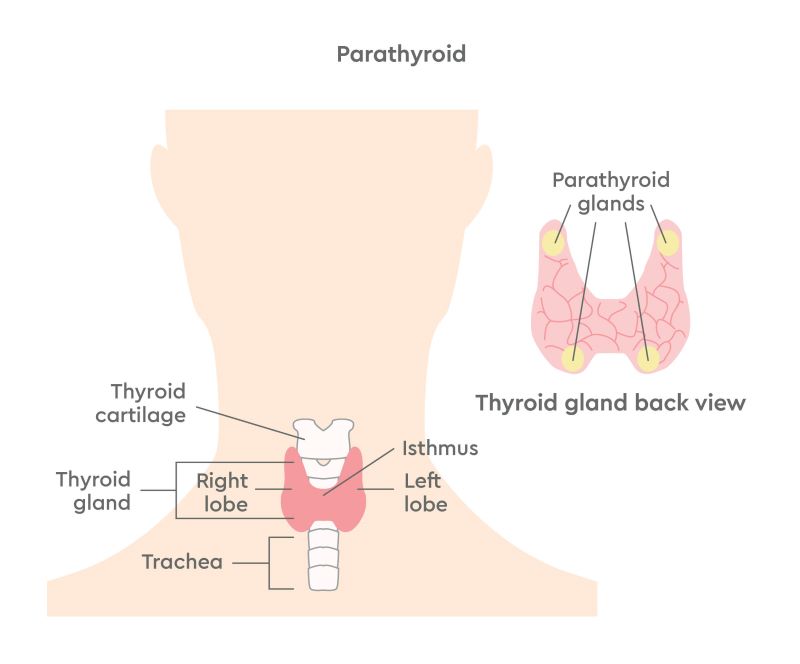
Thyroid goiters are when the thyroid, the butterfly-shaped gland in your neck, is larger than normal. When the thyroid is enlarged, it can impact the hormones that play a role in maintaining metabolism, body temperature, digestion, heart rate, and mood. Roughly 5% of people in the United States have a thyroid goiter.
Hyperthyroidism, also known as overactive thyroid, is when the thyroid, the butterfly-shaped gland in your neck, produces too much of the hormone thyroxine. This can increase your body’s metabolism and lead to certain health conditions such as rapid and unexpected weight loss, as well as an irregular heartbeat.
Thyroid nodules are small, solid, or fluid-filled lumps found in your thyroid, the butterfly-shaped gland in your neck. While most thyroid nodules are benign (noncancerous), roughly 5% to 15% of them can be cancerous.
Hyperparathyroidism occurs when the parathyroid glands produce too much parathyroid hormone (PTH), which regulates calcium levels. About 100,000 people in the U.S. are diagnosed each year.
Hypoparathyroidism
Hypoparathyroidism is an uncommon condition in which the body produces abnormally low levels of parathyroid hormone (PTH). parathyroid hormone. The low production of PTH in hypoparathyroidism leads to abnormally low calcium levels in the blood and an increase of phosphorus in the blood.8
Request more information
Head and neck treatments and surgery
Our head and neck surgeons are equipped with the latest technology and provide a wide range of advanced treatment options.
Browse head and neck surgery categories below to explore available treatments.
Cancer surgery
Oral cancer surgery
Surgery is often the first treatment used for these cancers. Several types of operations can be done to treat oral cavity and oropharyngeal cancers, depending on where the cancer is located and its stage. It's most commonly used for small, early-stage cancers that haven't spread. After the cancer is removed, reconstructive surgery might be done to help restore the appearance and function of the areas affected by the cancer or cancer treatment.9
Nasal cavity cancer surgery
Nasal cavity cancers are often removed in a procedure called wide local excision. This means removing the tumor plus an edge of normal tissue around it. The goal is to remove enough tissue so that no cancer cells remain. If the tumor is in the middle dividing wall of the nasal cavity (the nasal septum), sometimes the entire septum or a large portion of it will be taken out.10
Sinus cancer surgery
For most nasal cavity or paranasal sinus cancers, surgery to remove the cancer (and some of the surrounding bone or other nearby tissues) is a key part of treatment. Often, surgery is used with other treatments, like radiation therapy and/or chemotherapy to get the best results.11
Excision of salivary gland tumors
In most cases, some or all of the surrounding salivary gland will be removed. Nearby soft tissue may be taken out too. The goal is to have no cancer cells on the outside edges (margin) of the removed surgical tissue which contains the cancer. If the cancer is high grade (more likely to grow and spread quickly) or if it has already spread to lymph nodes, lymph nodes might be removed in an operation called a neck dissection.12
Surgeons use free flap surgery to reconstruct areas after head and neck cancer surgery by transplanting tissue from another part of the body. Based on the condition and circumstances, they may use different types of free flap surgery, such as those involving tissue from the forearm, thigh, or fibula. Blood vessels are microsurgically reconnected to ensure proper blood flow to the transplanted tissue.
Transoral robotic surgery (TORS) is a minimally invasive procedure that removes tumors from the back of the throat without the need for a mandibulotomy, which requires cutting through the jaw. Using the da Vinci® SP System, surgeons navigate the robotic system through the mouth to remove the tumor, avoiding external incisions.
Benign surgical procedures
Surgery of the larynx
Also known as a laryngectomy, larynx surgery is a surgical procedure to remove part or all of the larynx, the area of the throat that contains your vocal cords. It’s a treatment for laryngeal cancer or damage to the larynx from injury or other health complications.13
Surgery of the pharynx
Surgery of the pharynx, also known as a pharyngectomy, is the surgical removal of the pharynx, a cone-shaped cavity that connects the esophagus to the nose and mouth. The surgery is used mainly to treat cancer of the hypopharynx and conditions like pharyngitis.
There are various forms of the procedure. Some remove a portion of the pharynx (partial pharyngectomy) while others remove it completely (total pharyngectomy).14
Surgery of the trachea
Surgery of the trachea, or a tracheostomy (also called a tracheotomy) is a procedure where a hole is made at the front of the neck. A tube is inserted through the opening and into the windpipe (trachea) to help you breathe.15
Surgery of the esophagus
Esophagectomy is a surgical procedure to remove some or all of the tube connecting the mouth to the stomach, called the esophagus. The esophagus is then reconstructed using part of another organ, usually the stomach.
Esophagectomy is a common treatment for advanced esophageal cancer. It's sometimes used for a condition known as Barrett esophagus if precancerous cells are present.
An esophagectomy also may be recommended for noncancerous conditions when attempts to save the esophagus have failed.16
Surgery of the neck
The main objective of neck cancer surgery is to remove the cancerous tumor and some of the healthy tissue around it to ensure the removal of all cancerous tissue. The surgery may also be used to remove lymph nodes in the neck if there is a risk that the cancer has spread.
Depending on the location and stage of the tumor, surgery can vary from minimally invasive procedures to more extensive operations that may require reconstruction of the affected area.17
Surgical resections
Oropharyngectomy
Oropharyngectomy is the removal of part of the oropharynx. This is usually done for cancer of the oropharynx. The oropharynx is a difficult area to see and operate on because the teeth, jaw, and tongue are in the way. Sometimes tumors are removed through the mouth by holding the mouth open, this is called trans oral surgery.18
(TORS) radical tonsillectomy
Transoral robotic surgery (TORS) radical tonsillectomy is an emerging minimally invasive surgical procedure for the treatment of cancer of the tonsil.19
Base of tongue resection
A base of tongue resection, or a glossectomy, refers to the surgical removal of your tongue. Some people only need a portion of their tongue removed (partial glossectomy). Others may need half of their tongue removed (hemiglossectomy). Sometimes, it’s necessary to remove the entire tongue (total glossectomy).20
Thyroid and parathyroid procedures
Thyroid surgery treats conditions like goiters, hyperthyroidism, thyroid nodules, or thyroid cancer. Surgeons commonly perform hemithyroidectomy (partial removal), total thyroidectomy (full removal), and neck dissection (removal of lymph nodes). The type of surgery depends on the condition’s severity, cause, and individual needs.
Parathyroid surgery treats hyperparathyroidism, where overactive glands raise calcium levels, causing issues like weak bones and kidney stones. Surgeons may recommend targeted parathyroidectomy (minimally invasive), four-gland exploration (removing abnormal glands), partial parathyroidectomy (removing 3 or 3½ glands), or total parathyroidectomy (removing all glands, sometimes placing tissue in the arm).
Meet our expert physician
Dr. Scott Larson, Head and Neck Surgeon
Scott Larson, MD, Otolaryngologist at Head & Neck Surgical Cancer Specialists of SW Florida, has undergone extensive training to offer TORS and recently performed the first TORS procedure in Southwest Florida.
Request more information
- American Cancer Society, What Are Oral Cavity and Oropharyngeal Cancers?
- Clevenland Clinic, Oropharyngeal Cancer
- Mayo Clinic, Nasopharyngeal carcinoma
- Cleveland Clinic, Laryngeal Cancer
- Johns Hopkins Medicine, Hypopharyngeal Cancer
- American Cancer Society, Nasal Cavity or Paranasal Sinus Cancer
- Cleveland Clinic, Salivary Gland Cancer
- Mayo Clinic, Hypoparathyroidism
- American Cancer Society, Surgery for Oral Cavity and Oropharyngeal Cancer
- American Cancer Society, Surgery for Nasal Cavity and Paranasal Sinus Cancers
- American Cancer Society, Surgery for Salivary Gland Cancer
- Johns Hopkins Medicine, Laryngectomy Surgery
- Providence.org, Pharyngectomy
- National Health Service (UK), Tracheostomy
- Mayo Clinic, Esophagectomy
- Barrow Neurological Institute, head and neck cancer surgery
- Head & Neck Cancer (AUS), Oropharyngectomy
- National Library of Medicine, Transoral Robotic Surgery
- Cleveland Clinic, Glossectomy