

Parathyroid cancer treatment and diagnosis
Parathyroid Cancer
Parathyroid cancer is a rare form of endocrine gland cancer that develops in the parathyroid glands. It is estimated that less than 100 people in the US are diagnosed with parathyroid cancer each year. Benign (noncancerous) tumors of the parathyroid gland are much more common than parathyroid cancers.

Chapter 1
What is parathyroid cancer?
Your parathyroid glands are located in the neck, typically behind the thyroid gland. Most people have four parathyroid glands, each roughly the size of a pea. These glands produce parathyroid hormone (PTH), which helps your body create, store and maintain normal levels of calcium in the body. Calcium is critical for the maintenance of bone growth and structural integrity. Calcium levels vary normally with age, sex, body weight and various normal states such as pregnancy, or some illnesses.
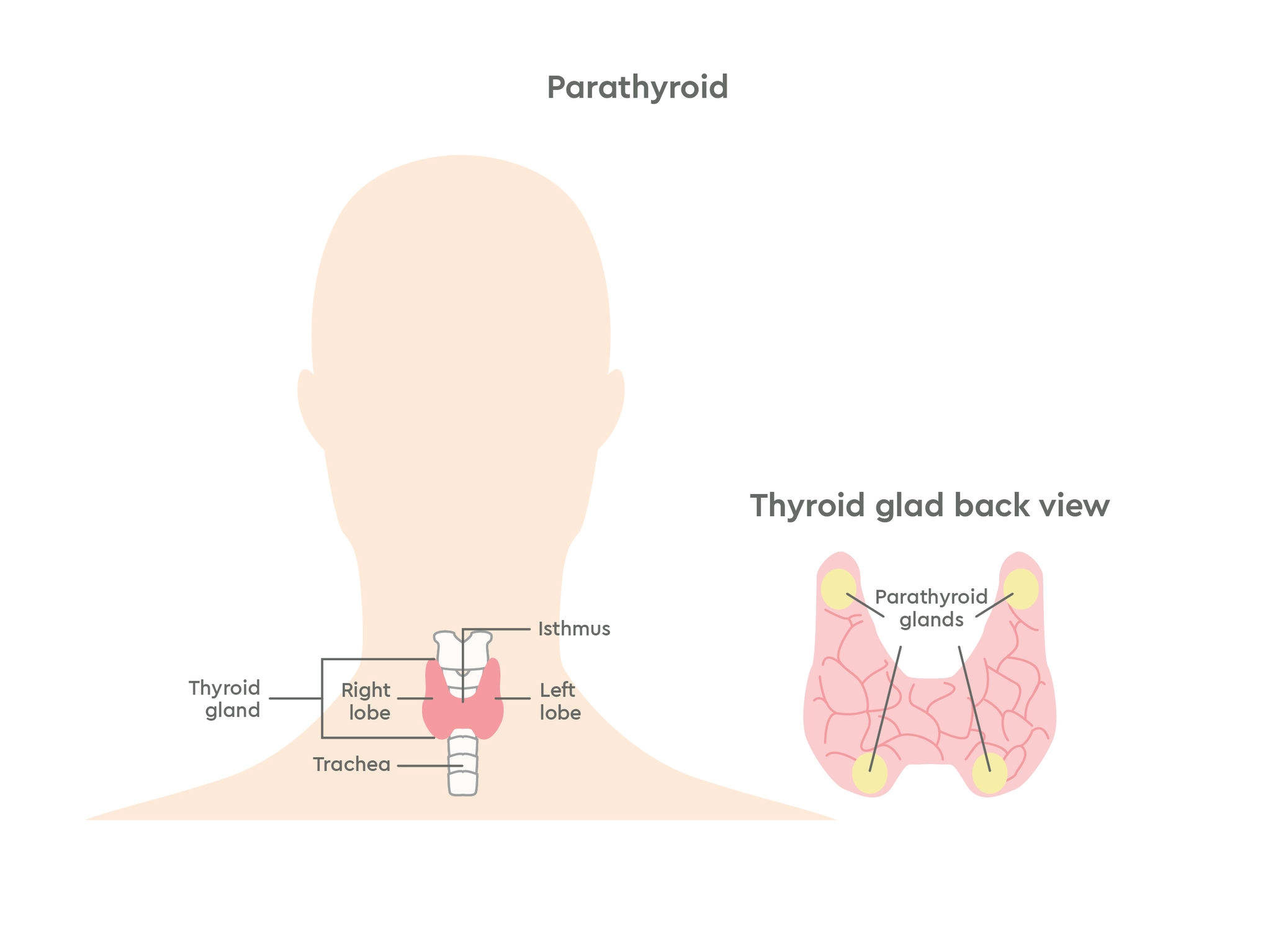
Parathyroid cancer is the development of a malignancy, usually only in one of the glands.
Risk factors for parathyroid cancer
The causes of developing parathyroid cancers are unknown. However, the following factors may increase your risk:
- A family history of parathyroid cancer
- Certain inherited conditions, such as familial isolated hyperparathyroidism, hyperparathyroidism jaw tumor (HPT-JT) or multiple endocrine neoplasia type 1 (MEN1) syndrome
- Personal history of thyroid cancer
- Previous radiation therapy to the neck
- Presence of hypercalcemia, an abnormally large amount of calcium in the blood
- Being over the age of 30 (parathyroid cancers are extremely rare in children or young adults)
Having a risk factor for parathyroid cancer doesn’t mean that you will get the disease, but it does make you more likely than someone without those risk factors. Talk to your healthcare provider about your individual risk factors.
Symptoms of parathyroid cancer
The signs and symptoms of parathyroid cancer often mimic the signs and symptoms of benign (noncancerous) thyroid tumors or other causes of hypercalcemia. They can include:
- A general feeling of weakness or fatigue
- Loss of appetite, nausea or vomiting
- Unexplained weight loss
- Thirst greater than usual
- Urinating more frequently than usual
- Chronic constipation
- Difficulty thinking clearly
Additionally, other signs and symptoms of parathyroid cancer can include:
- Pain in the abdomen, side or back that doesn’t improve with time
- A broken bone, fracture or general pain in the bones, especially with little or no trauma
- A lump in the neck
- Voice hoarseness
- Difficulties swallowing
- Kidney stones
If you are experiencing any of the above symptoms, it is important you talk to your healthcare provider. Having some of the above symptoms does not mean you have parathyroid cancer.
Causes of parathyroid cancer
If your body creates and releases too much PTH, you can develop primary hyperparathyroidism (pHPT) (overactive parathyroid function). This can cause the calcium levels in your body to rise and create a condition called hypercalcemia. When you have too much calcium in your blood, it can cause other issues such as weak or painful bones (because the excess PTH is pulling calcium from bones), kidney stones, overreactive bladder, fatigue or memory problems, to name a few.
In some instances when the body releases too much PTH, a condition called parathyroid adenoma can develop. Benign (noncancerous) parathyroid adenomas can usually be treated by surgery. In other instances, a cancerous tumor of the parathyroid can cause the overproduction of PTH. Less than 1% of hyperparathyroidism is caused by parathyroid cancer.

Chapter 2
Diagnosis
Because it can be difficult to determine if your symptoms are being caused by a benign parathyroid adenoma or parathyroid cancer, diagnostic tests are performed simply to determine which of the glands is overreactive, not to confirm the diagnosis of cancer. Your healthcare provider may use some combination of the following tests to help determine which gland is overreactive:
- Physical examination. Your healthcare provider will examine your neck to feel for any abnormal lumps. They will also likely ask you questions about your health history and symptoms.
- Blood test. You might have blood tests to check your general health, serum calcium levels or parathyroid hormone (PTH) levels in the body.
- Sestamibi scan. Your health care provider may request an examination in which a small amount of a safe radioactive agent, technetium 99, is injected into your bloodstream. This tracer substance travels through the body and attaches itself to the overactive gland. The substance lights up the gland in a picture taken by a sensitive camera.
- Imaging tests. Your doctor may order other imaging tests – such as a computerized tomography (CT) scan, or magnetic resonance imaging (MRI) – to get a closer look at the tissues of your neck, or elsewhere in your body.
Typically, parathyroid cancer is diagnosed only after the overreactive gland has been surgically removed.
Stages
Parathyroid cancer does not follow the standard staging as other tumor types (i.e., I, II, III or IV). Instead, it is typically described as either:
- Localized. The tumor is only found in the parathyroid and has not spread to any nearby tissues.
- Metastatic. The cancer has spread to areas outside of the gland, or to other areas of the body.
- Recurrent. The cancer has returned after initial treatment.
Chapter 3
Treatment options for parathyroid cancer
Typically, your care team will begin treatment for hypercalcemia (when there is too much calcium in the blood) first. This may include receiving intravenous fluids (IVs) and certain medications. Depending on your situation and the levels of calcium, and because parathyroid cancer is not diagnosed without surgical confirmation, your care team may recommend one or a combination of the following treatment options as well:
- Surgery. Typically, surgery is required for parathyroid cancer. At SunState Medical Specialists, we work with expert teams of surgeons who are experienced in the removal of parathyroid glands. Depending on your particular situation, some of the surrounding tissues and/or adjacent lymph nodes may also be removed. A few different surgical procedures may be used to treat parathyroid cancer, including:
- En bloc resection. During this procedure, your surgeon will remove the overreactive parathyroid gland, half of the adjacent thyroid gland on the same side, as well as some surrounding tissue. Part of the sternothyroid muscle, the overlying muscle in the center of the neck, and some nearby nerves may also be removed. En bloc resection is also known as a parathyroidectomy. Following surgery, the tumor will be examined by a pathologist to determine if it was cancerous or benign (non-cancerous).
- Neck dissection. Also called a lymphadenectomy, this procedure is performed to remove lymph nodes near the parathyroid gland that may contain cancer, decreasing the likelihood of further spread of cancer. The lymph nodes are examined by a pathologist after surgery to determine if any cancer is present. Your care team will use this information to guide further treatment recommendations.
- Tumor debulking. In this procedure, your surgeon will remove as much of the tumor as possible. This surgery is typically used only if the cancer is extremely large or has spread to other areas of the neck or chest.
- Metastasectomy. This surgery is performed if the cancer has spread, or metastasized, to other areas of the body. Your surgeon may remove as much of the spread tumors as possible. If all tumors have been removed, it is called a complete metastasectomy.
- Radiation therapy. Radiation therapy may be recommended after surgery to help destroy any remaining microscopic cancerous cells that surgery was unable to remove, or if there is a high suspicion regarding the presence of remaining cancer. This treatment may reduce the chances of the cancer returning. Radiation therapy can kill cancer cells. At SunState Medical Specialists, we offer various techniques to deliver external beam radiation therapy (EBRT), in which a device outside the body delivers radiation. In rare instances, we may employ internal radiation therapy (brachytherapy), in which a radiation source is inserted directly within the parathyroid gland or adjacent lymph nodes.
- Chemotherapy/Biological Therapy. Chemotherapy or biological therapy refers to drugs administered by mouth or vein, that may destroy cancer cells, or prevent them from growing. While this approach is not typically recommended for newly diagnosed parathyroid cancer, it may be used to treat cancer that has spread or returned. The type of chemotherapy or biological therapy you’ll have will depend on your individual situation.
Chapter 4
Find a specialist in our network
Connect with a physician who specializes in your condition and can help guide your path to better health. SunState Medical Specialists physicians are based in Florida and currently accepting new patients. Find a physician near you and take the next step toward care.