

Colorectal cancer treatment and diagnosis
Colorectal Cancer
We offer many of the latest technologies to treat colorectal cancer from around the world that are proven to be effective. Our team of experts specializing in colorectal cancer will be with you every step of the way, from diagnosis to treatment and beyond, to ensure that you receive the best possible care during your time with us. Colorectal cancer is the fourth most common cancer type in the U.S.. However, early diagnosis and effective treatment can mean a positive outcome for many.

Chapter 1
Diagnostics
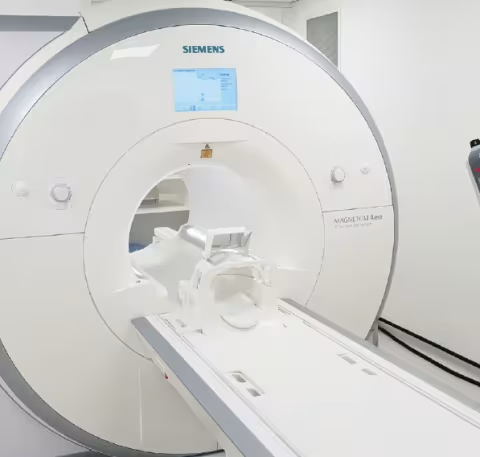
Colorectal cancer is often diagnosed with colonoscopy and a biopsy, although your doctor may use other tests to identify the problem. You may also have imaging scans, such as MRI and CT, and other tests to find out more about your cancer, where it’s located and which treatments are likely to be most effective. Some of these tests are also used to assess how well your treatment is working.

Find your nearest SunState Medical Specialists center to find out what diagnostic tests and scans are available in your local area. Whatever your outcome, our expert team will support you throughout your treatment journey.
Chapter 2
Surgery
We work with expert teams of surgeons who are specially trained in surgical removal of benign (non-cancerous) and malignant (cancerous) tumors of the colon. There are different procedures used for colorectal surgery and your surgeon will recommend the most appropriate one for you depending on your tumor size and its location.
Polypectomy
Small cancers that are in their early stage and contained in the polyp can be removed during a colonoscopy – where a flexible tube with a camera is passed through the rectum. A polypectomy is commonly performed with a wire loop that is passed through the colonoscope and used to cut the polyp with an electrical current.
Local excision
Your surgeon can also remove larger polyps during a colonoscopy. In this instance, surgical equipment is passed through the colonoscope and is used to remove the polyp and a small part of the healthy colon lining that surrounds the cancer. This procedure is also called an endoscopic mucosal resection.
Partial colectomy
For more advanced cancers that have spread throughout the colon, your surgeon may recommend a partial colectomy. In this procedure, you’ll have the portion of colon that contains the cancer removed, along with some healthy parts of the colon either side. Your surgeon may also reconnect the ends of the colon and rectum after surgery.
Low anterior resection
This procedure is similar to a partial colectomy but for cancers that are in the rectum. During a low anterior resection operation, the cancerous part of your rectum will be removed, along with some nearby tissue and lymph nodes. The end of your colon is then reattached to the remaining part of your rectum. Your surgeon may recommend this if your colorectal cancer is large but far enough from the anus so that waste can leave your body normally.
Total colectomy
In some cases, your surgeon may have to remove all of the colon, this is called a total colectomy. This isn’t commonly used to treat colorectal cancers, but it may be necessary if you have an additional condition in another part of your colon, such as familial adenomatous polyposis or inflammatory bowel disease.
Colostomy
In colorectal cancers that are blocking your colon or rectum, or are located near your anus, you may require surgery to create a new way for your waste to leave the body. Your surgeon will cut out a portion of your colon or rectum and attach the end to a stoma – an opening in the skin of the abdomen. This can help you recover enough to start other treatments, such as chemotherapy. The type of colostomy you’ll have will depend on which part of your colon or rectum is cut out. In some cases, this is only temporary, and your colon and rectum can be surgically put back together in a separate procedure.

Chapter 3
Radiation Therapy
At SunState Medical Specialists, we specialize in advanced radiation therapy techniques that are designed to be effective and minimize the side effects you’ll experience. As a leader in cancer care and other challenging conditions, our broad experience and world-class expertise means we offer advanced and innovative radiation therapy as standard.
Our latest-generation machines are built to deliver highly targeted radiation beams. The accuracy of these treatments, together with the expertise of our teams, helps our patients achieve the best possible outcomes.
The type of colorectal cancer treatment your radiation oncologist recommends will depend on your diagnosis, if the cancer has spread to other parts of your body, your general health and personal preferences.
Radiation therapy for colorectal cancer
External Beam Radiation Therapy (EBRT)
At SunState Medical Specialists our colorectal cancer treatments include External Beam Radiation Therapy (EBRT), where radiation is delivered from outside the body, and Internal Radiation Therapy (IRT), where the radiation dose is given via a source implanted within the body.
Intensity-Modulated Radiation Therapy (IMRT)
IMRT is an advanced external beam radiation therapy technique where the beams of radiation are precisely shaped to exactly match your tumor and damage to adjacent healthy tissues is limited.
High-Dose Rate Brachytherapy
HDR brachytherapy is an internal radiation therapy that delivers radioactive pellets to the tumor site through small plastic tubes called catheters. This is usually done in one session and the radioactive pellets are removed after 20 minutes.
Chapter 4
Medical Oncology
At SunState Medical Specialists, we offer various drug therapies and a wide range of the latest anti-cancer drugs for colorectal cancer treatment, including chemotherapy, targeted therapy and immunotherapy.
Chemotherapy for colorectal cancers
Chemotherapy refers to drugs that destroy cancer cells. Our expert teams may recommend chemotherapy before or after other treatments, or on its own. It can also be combined with radiation therapy (chemoradiation)
Immunotherapy for colorectal cancer
Immunotherapy helps your body’s own immune system to recognize and fight the cancer, it can be used to treat some kinds of advanced colorectal cancer.
Targeted therapy for colorectal cancer
As researchers know more about colorectal cancer, they have developed new treatments that can specifically target it. We use targeted therapy to seek and attack cellular activity that the cancer depends on to survive and grow. They are used depending on the specific genetic make up of your cancer. Types of targeted therapy for colorectal cancer include:
- Agiogenesis inhibitors – suitable for some colorectal cancers, work by blocking the protein VEGF which promotes new blood vessel formation and helps tumors grow
- Monoclonal antibodies – work by specifically attaching to the special proteins found on the outside of some colorectal cancer cells which usually encourage the tumor to develop
- RTK inhibitors – block the proteins that are found near and on the surface of the colorectal cancer cells which help the tumor grow. They also stop the proteins that help create new blood vessels

Chapter 5
Find a specialist in our network
Connect with a physician who specializes in your condition and can help guide your path to better health. SunState Medical Specialists physicians are based in Florida and currently accepting new patients. Find a physician near you and take the next step toward care.

Chapter 6