
What is IGRT?
How does IGRT work?
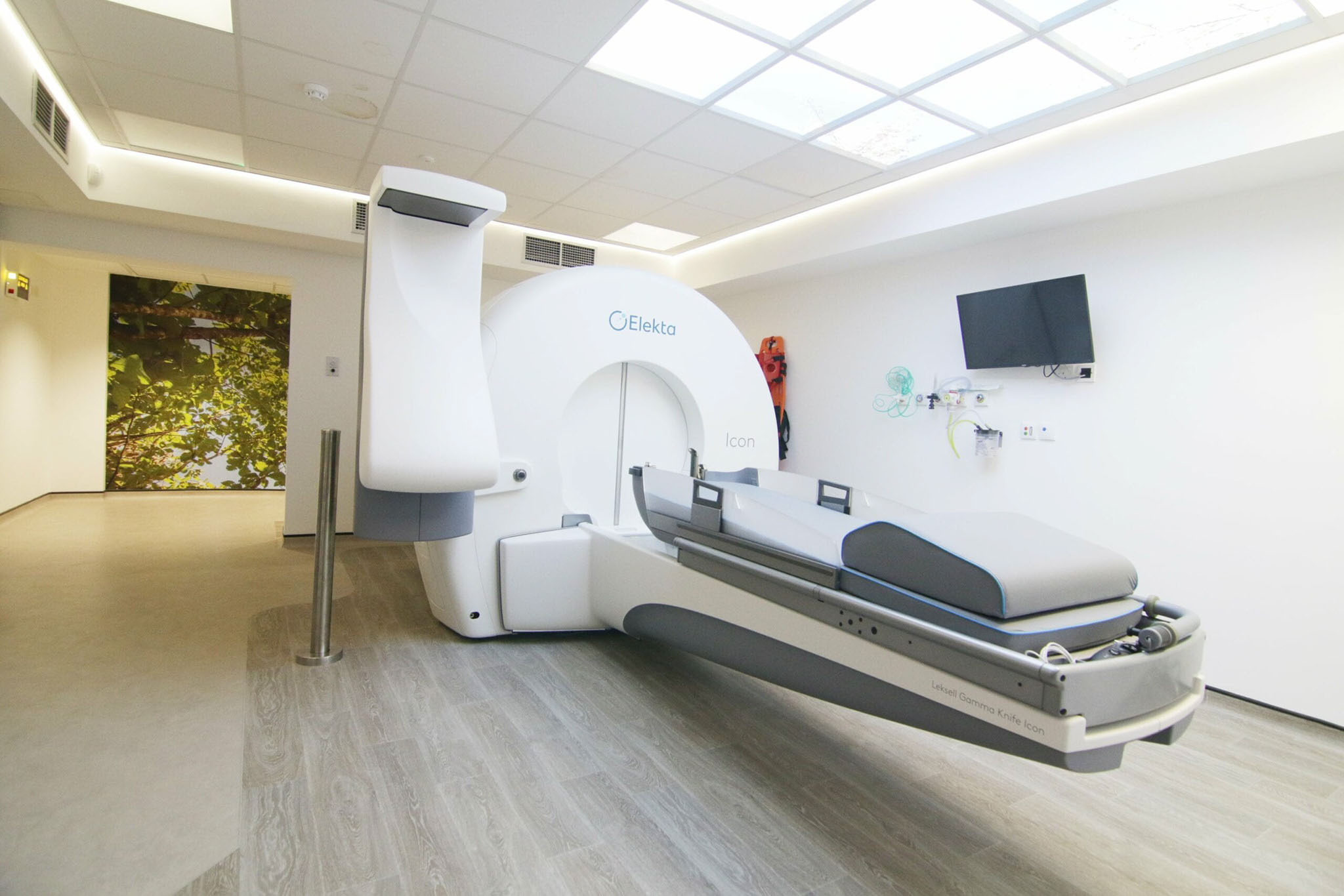
Your radiation therapy team performs an imaging scan (either a CT scan or a set of X-rays) immediately before treatment and while you’re on the treatment table. IGRT is performed on a machine called a linear accelerator (or linac), which will also deliver your radiation. You’ll lie down on the treatment table and a three-dimensional (3D) shape of the entire treatment area can be imaged in less than a minute.
During each subsequent radiation therapy treatment session, your radiation team will take a new CT scan or set of X-ray scans prior to treatment and compare the image to the original taken before your treatment commenced. This will help us confirm that you’re in the correct position or determine if your tumor has shifted or altered in shape. We can then make tiny adjustments to precisely target the treatment area with radiation.
To ensure your tumor is always targeted precisely, we use daily image-guided radiation therapy every time radiation therapy is delivered. Some providers only carry out image guidance at the start of your treatment, or once or twice during the weeks of radiation therapy. Others may offer daily imaging, but it may not be applied on the same day as your treatment session. Research has shown that using daily image-guided radiation therapy during each delivery is more effective and fewer side effects are experienced.
What about side effects?
As with any cancer treatment, you may experience side effects. What you experience is often dependent on the location of the tumor. Your physician will discuss with you the side effects you are likely to experience. However, IGRT alone does not have any additional side effects to the treatment process.
We know that it can be tough to fit regular appointments into your busy life. So, we’ll do our best to arrange your appointment times to suit your schedule. Our convenient treatment locations mean you can access world-class cancer care close to home, so you can focus on your life and doing the things you love, while we focus on treating your cancer.