

Kidney cancer treatment and diagnosis
Kidney cancer
We specialize in the latest technologies to treat kidney cancer that are proven to be effective. We work with teams of kidney specialists who will be with you every step of the way, from diagnosis to treatment and beyond, to ensure that you receive the best possible care during your time with us. Kidney cancer is one of the most common cancer types among Americans and in 2019 there were an estimated 75,000 new cases in the U.S. Early diagnosis and effective treatment can mean a positive outcome.

Chapter 1
Diagnosis
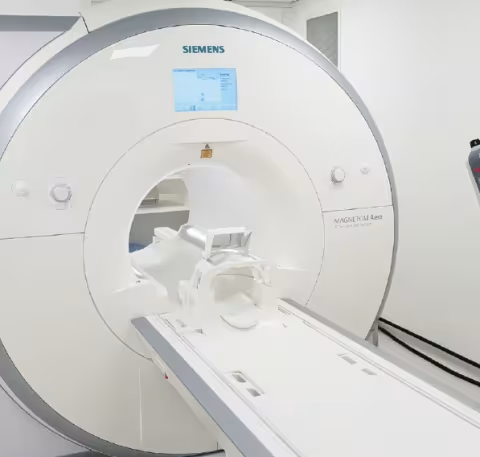
Kidney cancer is often diagnosed with pathology tests, such as a biopsy and blood tests, and imaging scans such as CT and MRI, although your doctor may use other techniques to identify the problem. You may also have other advanced tests to find out more about your cancer, where it’s located and which treatments are likely to be most effective. Some of these tests are also used to assess how well your treatment is working.
Find your nearest SunState Medical Specialists center to find out what diagnostic tests and scans are available in your local area. Whatever your outcome, our expert team will support you throughout your treatment journey.
Request more information
Contact us today to find out how SunState Medical Specialists can help you.

Chapter 2
Surgery
We work with expert teams of renal surgeons who are specially trained in surgical removal of benign (non-cancerous) and malignant (cancerous) tumors of the kidney. There are different procedures used for the kidney cancer treatment and your surgeon will recommend the most appropriate one for you depending on the size and location of your tumor and how well your kidneys are functioning.
The most common procedure for early-stage kidney cancer is partial nephrectomy. Your surgeon removes the part of the kidney where the small tumors are located, leaving the rest of the kidney behind. In more advanced cases, a radical nephrectomy may be performed to remove the whole kidney. During this procedure, your surgeon typically also removes your adrenal gland, nearby lymph nodes and fatty tissue surrounding the kidney.

Chapter 3
Ablation
Ablation is not often used for kidney cancer, but if the tumors are small and you aren’t fit enough for surgery, it may be an option. With image-guided ablation therapy, your clinician uses an imaging technology such as a CT scan or MRI to guide the ablation technology to the tumor site. Ablation technology includes:
- Cryotherapy – using extreme cold to freeze and destroy the tumor
- Radiofrequency – using high-energy radio waves to heat and destroy the tumor

Chapter 4
Radiation Therapy
External beam radiation therapy (ERBT)
External beam radiation therapy (ERBT) delivers high-powered X-rays from outside the body, precisely targeting and shrinking or destroying tumors. Radiation therapy may be recommended if you’re not suitable for surgery or if you only have one kidney.
At SunState Medical Specialists we offer fast access to the latest technologies and treatments that have been proven to make a difference. These include:
Intensity-modulated radiation therapy (IMRT)
IMRT is an advanced external beam radiation therapy technique where the beams of radiation are precisely shaped to exactly match your tumor and damage to adjacent healthy tissues is limited.
Stereotactic body radiation therapy (SBRT)
SBRT uses extremely focused, high-energy radiation beams to destroy tumors in few treatment sessions, sometimes five or less. It can used as an alternative to surgery.
Chapter 5
Medical Oncology
Chapter 6
Advanced disease
If kidney cancer has spread to other parts of the body, it’s called advanced or metastatic kidney cancer. There are treatment options for advanced kidney cancer at SunState Medical Specialists and our goal is to deliver exceptional treatment and care in a way that enhances every aspect of your cancer journey.
Palliative radiation therapy
Palliative radiation therapy does not aim to cure advanced kidney cancer, but is used to help shrink, slow down the growth, or control your symptoms to give you a better quality of life. Most people don’t need long courses of palliative care, it might be anything between one and ten treatments. However, it’s not suitable for everyone. Your primary care physician is the best person talk with about the best way forward for you.
Chapter 7
Find a specialist in our network