
Non-melanoma Cancer
Skin cancer is the most prevalent cancer type in the US. Each year, it is estimated there will be 5.4 million non-melanoma skin cancers (NMSCs) diagnosed in the US, with some people being diagnosed with more than one type of NMSC.
Despite the high occurrence of NMSC, almost all can be successfully treated. Unlike many other cancers, there’s a low risk of NMSC spreading to other parts of the body. This means early diagnosis and treatment can result in a positive outcome for most people.

Chapter 1
What is NMSC?
NMSCs are a group of skin cancers that develop in the upper layers of your skin. They can occur anywhere on the skin, though they’re most commonly found on parts of the body that have experienced long-term sun exposure – like the head, face, neck, arms, legs, and back of the hands. While ultraviolet radiation (UVR) through tanning and inadequate sun protection are the largest risk factors of developing NMSC, those at higher risk also typically have fair skin, a history of ionizing radiation (x-rays, gamma rays), a suppressed immune system or a history of skin cancer.
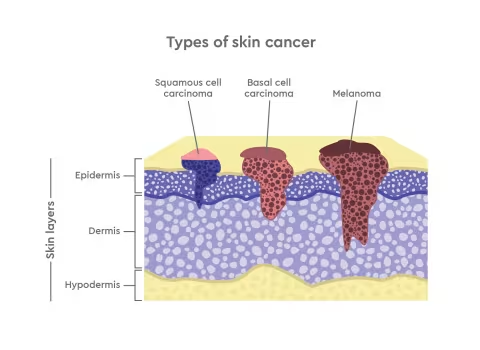
Although there are several types of NMSC, there are two main types: basal cell carcinoma (BCC) and squamous cell carcinoma (SCC). BCC makes up around 80% of all non-melanoma skin cancer cases whereas SCC is less common.
- Basal cell carcinomas (BCC) – Basal cell carcinoma begins in the basal cells of the skin, which are found at the bottom of the epidermis skin layer. BCCs typically remain in one place, but they can sometimes metastasize, or spread, to other nearby areas. In rare instances, they can spread to lymph nodes or other sites in the body. BCCs are the most common type of NMSC.
- Squamous cell carcinomas (SCC)– Squamous cell carcinoma develops in the squamous cells, which make up the middle and outer layers of the skin. Although they’re not usually life-threatening, some high-risk SCCs have the potential to metastasize to lymph nodes or distant sites in the body. Treatment may be less successful if other parts of the body have been affected.
Lack of sun protection is one of the highest risks of developing NMSC.
The most common risk factor of developing NMSC is ultraviolet radiation (UVR) through tanning and inadequate sun protection Those at higher risk also typically have fair skin, a history of ionizing radiation (x-rays, gamma rays), a suppressed immune system or a history of skin cancer.
There are several other known factors for skin cancer. Having a risk factor for a disease doesn’t mean that you will develop it, but it makes it more likely.
You’re more likely to develop skin cancer if you:
- Are older
- Have a family history or personal history of skin cancer
- Have a rare type of birthmark – known as giant congenital melanocytic naevus
- Spend lots of time in the sun
- Have fair skin which burns easily
- Have blonder or red hair, or blue or green eyes
- Have reduced immunity or HIV
- Have moles – the more moles you have, the higher the risk
- Have another medical condition – such as Chron’s disease, ulcerative colitis or sarcoidosis
- Have received an organ transplant
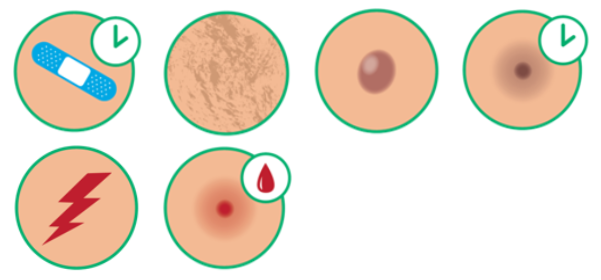
- A pink or red spot that doesn’t heal
- A scaly area of skin that doesn’t heal
- Smooth lumps with a pearly appearance
- Red or dark colored spots or sores that don’t go away after one month
- Red or dark colored spots or sores that are painful, itchy or bleeding
- Broken skin which doesn't improve within one month
- Red patches on your skin
Having one or more of these skin cancer symptoms doesn’t mean you have cancer, as they may be caused by other, benign (non-cancerous) conditions. It’s best to speak to your primary care physician for advice if you have any concerns.
Chapter 2
Diagnostics
Typically, NMSC are associated with a mole or growth that changes in size, shape and color, a new growth on the skin, or a sore that does not heal. Your physician may want to run diagnostics if there is any concern of malignancy.
Following a physical examination, NMSCs are usually diagnosed by a biopsy. In some instances, a biopsy can remove all cancer tissue and no further treatment is required. If necessary, imaging scans such as CT and MRI may be used for a diagnosis. You may also have advanced diagnostic tests throughout treatment to assess effectiveness and how your cancer is responding.

Request more information
Contact us today to find out how SunState Medical Specialists can help you.
Chapter 3
Surgery
Chapter 4
Radiation therapy
Chapter 5
Medical oncology
Chapter 6
Find a specialist in our network
Connect with a physician who specializes in your condition and can help guide your path to better health. SunState Medical Specialists physicians are based in Florida and currently accepting new patients. Find a physician near you and take the next step toward care.